We are building a protocol and a benchmark for using Claude Code–style agentic orchestration in games — simulation, role-playing, narrative, and world-model-driven experiences.
The point isn’t another AI TRPG demo. It’s the runtime layer underneath those games: worlds, characters, memories, rules, and narrative coordinated by specialized agents — inspectable, swappable, and benchmarkable the way game engines have been for twenty years.
Three pieces of work.
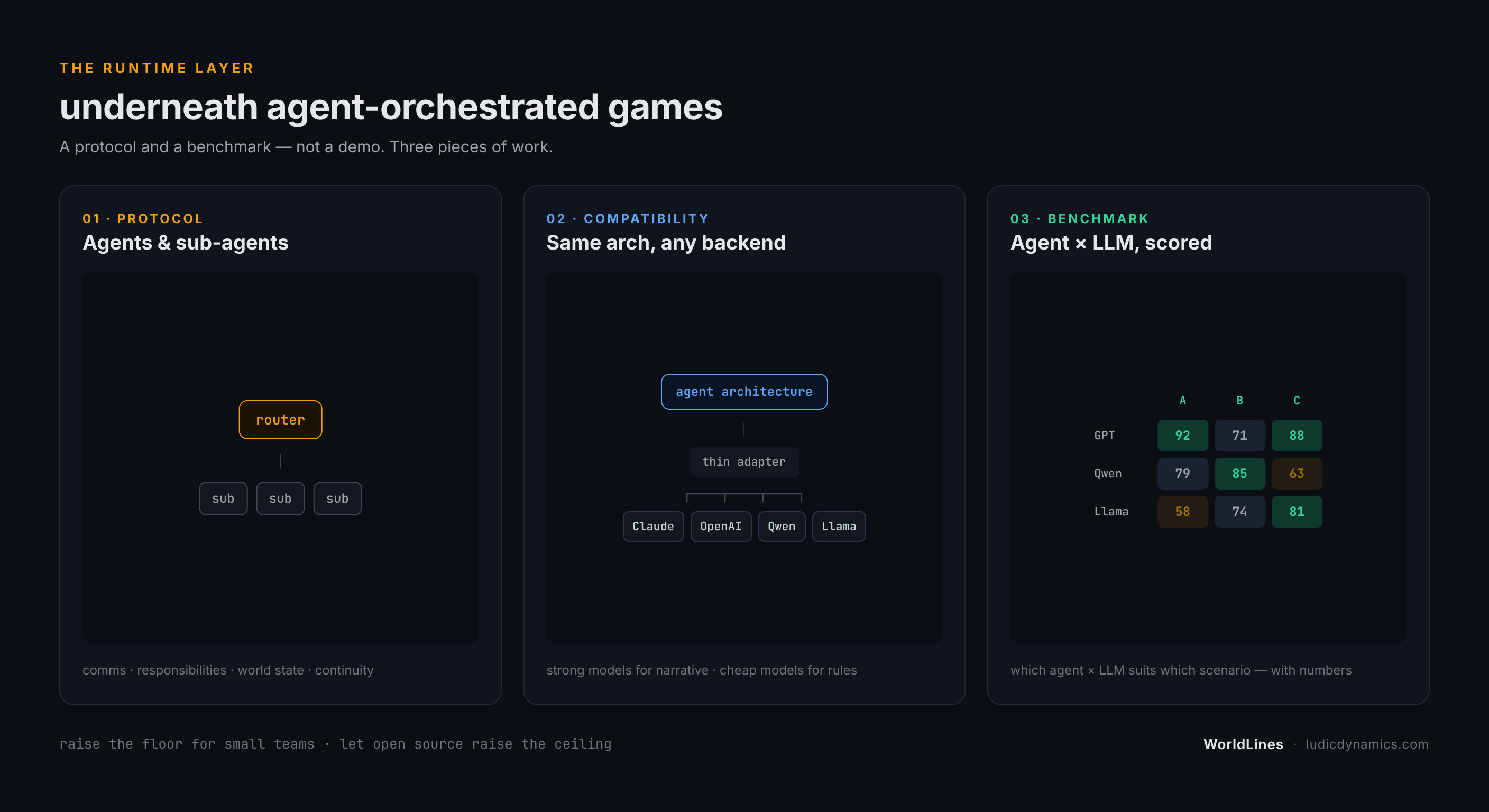
A protocol for agents and sub-agents
Inspired by Claude Code’s router → sub-agent style, adapted for game worlds. The protocol defines:
-
how agents communicate — message shape, tool surface, state hand-off
-
how responsibilities are divided — who reads what, who writes what
-
how world state is updated — files vs. structured event log
-
how characters maintain continuity — per-character memory layout
-
how freedom is balanced against narrative consistency
Today this lives as conventions inside the WorldLines repo. The work is to lift them into something other teams can read, implement, and disagree with.
Compatibility across agent systems and low-cost LLMs
We don’t want a Claude-only club. A rich role-playing turn composes dozens of agent calls; if every call needs a frontier proprietary model, the economics break for everyone except a few studios.
Concretely:
-
a thin runtime adapter (Claude Code, OpenAI-compatible APIs, local Qwen / Llama-class, future agent SDKs)
-
per-agent model selection — strong models for narrative, cheap models for rules
-
a quality/cost frontier we can keep pushing, not a single price point
Same architecture, different backends, better cost-per-session over time.
Benchmarks for agent × LLM combinations
Public LLM benchmarks measure what role-playing cares about only indirectly — recall, math, code, instruction following. None tell you whether a model keeps an NPC consistent for forty sessions, or whether an agent-LLM pairing handles emotion without collapsing into generic encouragement.
We’re building benchmarks that evaluate agent orchestration systems and language models together. Results published per combination: “model X under agent system A scored Y; same model under system B scored Z.” Targets:
-
character consistency across sessions
-
long-term memory retrieval
-
world simulation when the player is away
-
emotional interaction
-
narrative control across an arc
-
multi-character coordination
Output: a map of which agent-LLM configurations suit which role-playing scenarios, with numbers.
Where this is going
AI-native games should feel less like isolated chatbot conversations and more like living worlds — continuous, agentive, remembering what the player has done. The protocol, the compatibility layer, and the benchmarks all serve that same target: raise the floor for small teams, let the open-source ecosystem keep raising the ceiling.
More to say as each piece lands.