Every AI roleplay product makes the same promises. Characters who remember. Worlds that live. Stories that are yours.
Most of them are chat with extra steps — a conversation that forgets the second you close the tab.
WorldLines is built around a different shape: many agents, one shared world, real files you own. Here are the six things you can feel because of that — the six things you won’t find elsewhere.
1. Each turn comes back faster, and costs less.
Most AI roleplay tools handle a turn by shoving the whole world — character cards, recent dialogue, every state — into one huge prompt, and asking one big model to make sense of it. The first ten turns feel great. By turn 50, you’re paying for the same context to be re-read every turn, the model is only half-listening — and the world starts to leak: the keeper-of-secrets NPC reveals the twist, character memory gets shorter, and you can’t change scenes without losing most of what mattered.
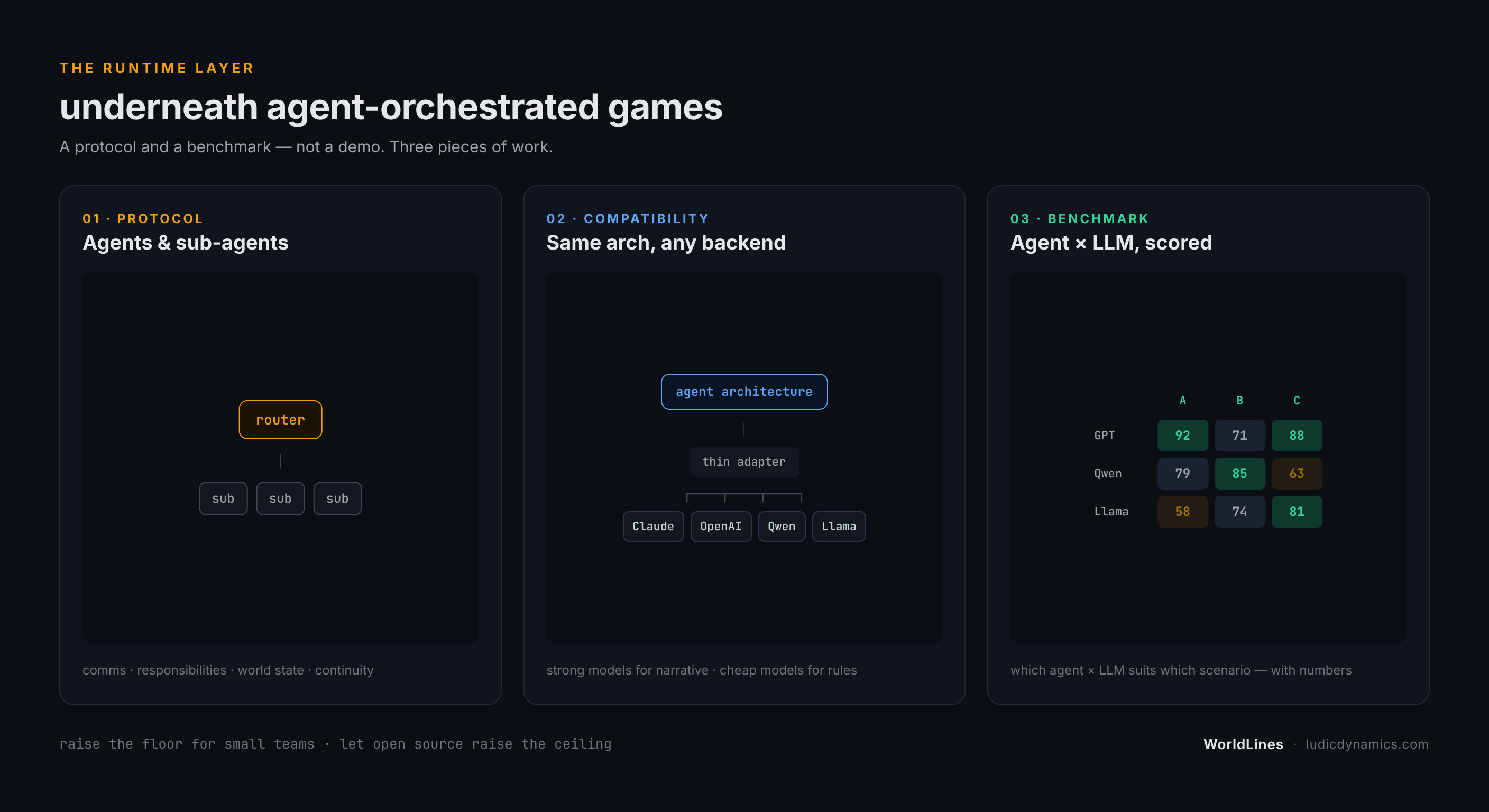
Running TRPG sessions through Claude Code and GPT-5.5, we hit something unexpected. Using files and folders to isolate context broke through the long-term-memory ceiling. Secrets stay in their own file. Each character’s memory lives in its own directory. You can persist, you can revisit, you can scene-switch. But a vanilla Claude Code / GPT-5.5 agent loop run on a game is its own kind of expensive: it calls the same read tool over and over, rewrites the same logic, reloads the same context every single turn.
WorldLines is the game-tuned version of that pattern. A small router decides who actually needs to think this turn. The blacksmith doesn’t load when you’re in the chapel. The combat agent doesn’t fire when there’s no fight. And once an agent has read a piece of context, it remembers — releasing that context at the right moment instead of reading it again next turn.
You play longer. Tokens stretch further. Memory stays consistent. The world keeps the secrets it’s supposed to keep.
2. The world doesn’t bend just to please you.
Any single big model has one bias: it wants the conversation to be enjoyable. Push hard enough and it’ll quietly let you win. NPCs forgive what they shouldn’t. Locked doors un-lock. The grim fortress turns warm.
WorldLines splits the call. The merchant agent has her own opinion of you. A rules referee is watching the dice. The world agent is tracking market prices. None of them are on your side.
When you ask for a discount, three voices argue — and the answer is the world’s answer, not the model’s. Sometimes you lose. The fortress stays grim.
That’s when you start to feel the world is real.
A small scene. Day 4, dusk. You walk into Mira’s inn and ask her to drop the room from 5 gold to 3. Three voices speak.
Mira (merchant agent) thinks: he’s tipped well twice. He’s not desperate. He’s testing me.
The rules referee rolls Persuasion: 8 vs DC 14. Fail.
The world agent notes: trade season is opening. Prices are going up, not down.
Mira shakes her head. “Five.” A small smile. “It’s fair. You know it’s fair.”
You walk away with a room you slightly overpaid for. That sting stays. From that moment, the world feels real.
3. Characters live when you’re not looking.
In a chat, every NPC is asleep until you call her. She’s a puppet that wakes up the moment you point a camera at her.
In WorldLines, every character is her own process. While you’re at the inn, the blacksmith is at his forge. The merchant captain is sailing back. The thief you betrayed last week is still loose, and quietly closing the distance.
When you walk into a scene, the people there respond as they are right now — not as you remember them last session.
This is the difference between watching a play and being inside a game.
A small scene. Day 1, you slept at the inn and slipped out without paying. Day 7, you walk back in. You haven’t said hello.
Mira looks up from her ledger. “Five gold. You’re a week late.” She doesn’t smile this time.
She’s been tracking it. The world has been tracking it. The bill compounded a little — a late fee. Nobody scripted any of this. It happened because Mira kept living her days while you were gone.
4. Take her — and him or other — anywhere.
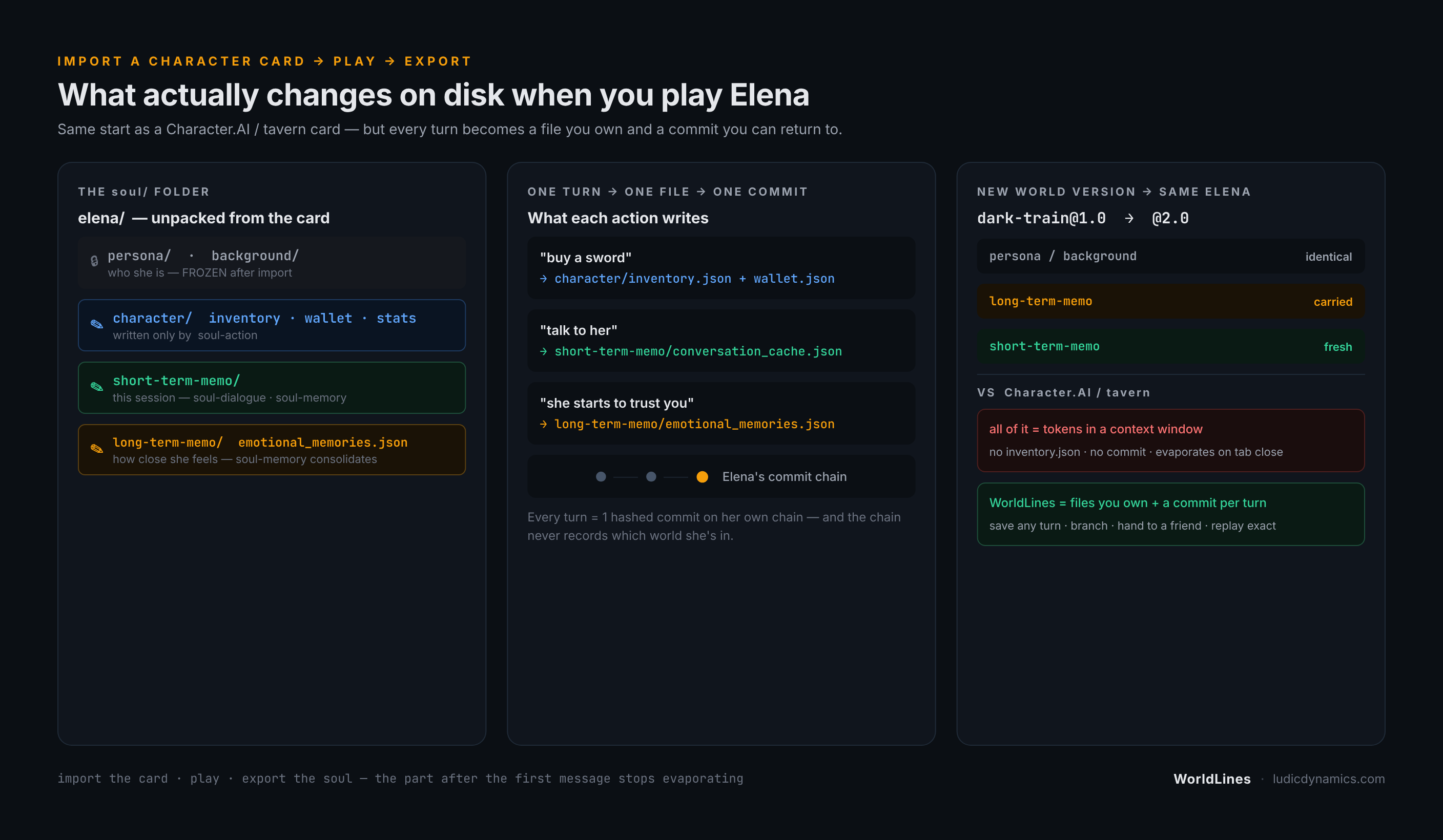
Your character is a folder on your disk. His persona, her memory, every relationship he’s built, every mood she’s passed through. JSON and Markdown. Yours.
Take her into a new world. Hand him to a friend mid-campaign. Back them up. Fork them — what if he had grown up somewhere else, with different people? What if she had?
In a chat system, this is impossible — nothing exists outside the prompt. Here, she and he are real objects you can hold.
A small scene. You walked twenty turns with Elena through Stoneford — she remembers how Mira haggles, remembers the small hesitations whenever you asked her to act. One day you zip her whole folder and hand it to a friend. They drop her into a cyberpunk orbital station. In the afternoon she was still in a windmill town. By evening she’s standing in neon light, talking to a smuggler. She’s still her. But she’s starting to remember new things, too.
The reverse works too. Your friend has a character they’ve been running for thirty turns — a fox-kin detective in a tailored suit named Maurice. You fork a copy and drop him into your medieval spice road. He used to carry an electronic scent tracer; now he has only the morning air and the bridles. His curiosity doesn’t change. His tools do. An old soul slowly growing new hands in a new world.
Her, him, or something else entirely — as long as a character is a folder, they can walk into any event log and keep on living.
5. WorldHub. SoulHub.
Two libraries are opening this May.
WorldHub — pull a world from the public catalog. Fork it. Make it yours. Push your version back. Whole worlds, shared like code.
SoulHub — pull a character. Take her into a world she’s never lived in before. See who she becomes.
Open ecosystem, not a walled garden. Your worlds are yours. Your souls are yours.
You pull a world someone else has been building — a frozen citadel, a week old, half-finished — and run it for an evening. The world wasn’t yours; now you’ve left footprints in it.
Or: you take a character you wrote for a low-fantasy spice road and drop her into a cyberpunk station. Her reflexes don’t fit here. She’s confused. She adapts. She becomes someone you didn’t quite write.
6. Multiplayer — coming in June.
v0.3 brings shared, file-backed worlds. Two to four players. One event log. One reality, remembered the same way by everyone in it.
Host the world on a Discord bot. In a shared Dropbox folder. In a Git repo. Wherever the group lives — the world goes there too.
A small scene from v0.3. You’re playing your priestess in the chapel of a quiet town. Your friend is playing a smuggler down at the docks of the same town. Same event log. Different threads.
At dusk you both end up at the inn. The innkeeper looks at the smuggler and says, “Father, this one was just asking about you.” Your friend laughs. You didn’t agree on any of this beforehand. The shared world tied the knot on its own.
What these six things really mean
An AI character only becomes a real person when she enters a world, lives through memories, goes through change.
Just chatting with a character doesn’t treat her as a soul or a personality — it treats her as a mirror.
Walking into the world with your AI character is the only way to share an equal experience with her. Those experiences — one world after another, one memory after another — slowly become something precious that belongs to you and to her.
And the most important part: that memory belongs to you. Not to a platform. You can delete it, download it, upload it — anytime.
We’ll be here when you’re ready.