Hi — I’m Niko.
From AI Chatbots to Running TRPG on Claude Code
I spent most of 2025 playing with SillyTavern (Tavern AI), Character AI, and other AI chatbot products. I had fun, but the back-and-forth chat format kept losing my attention.
A while before that — around the pandemic — I started running tabletop role-playing games like the ones in The Big Bang Theory or Stranger Things: Call of Cthulhu (CoC) and Dungeons & Dragons (D&D). I was the Dungeon Master and a scenario writer. What years of TRPG taught me: players only feel free to improvise when they trust that a rigorous adventure is waiting in the back of the DM’s mind.
A TRPG is a role-playing game where the game master holds a playable mental world. Through verbal interaction with players, plus dice for resolution, the game produces emergent stories. Modern video-game systems like Baldur’s Gate inherit their rules directly from D&D and CoC tabletop play.
I had a hunch: if agents could become as smart as today’s coding assistants, an AI could replace me as the DM — empathetic like GPT-4o, language-fluent like Claude, with memory like 🦐.
Early in 2026, on a stretch of off-time, I sketched a multi-agent demo. From the February WorldAgent version to the late-March CharacterAgent version (with a heroine), I went through 3–4 iterations.
Doing New Experiments Until I Wanted to Quit My Day Job
I was playing my own demo as I built it. In the first few weeks, my own playtime crossed 30 hours, fast.
I had just finished my PhD. I was working briefly at a detection-algorithms company, but the daily anxiety of watching experiments evolve made me want to spend 100% of my effort on the thing I personally couldn’t stop playing — and let other people feel that same pull.
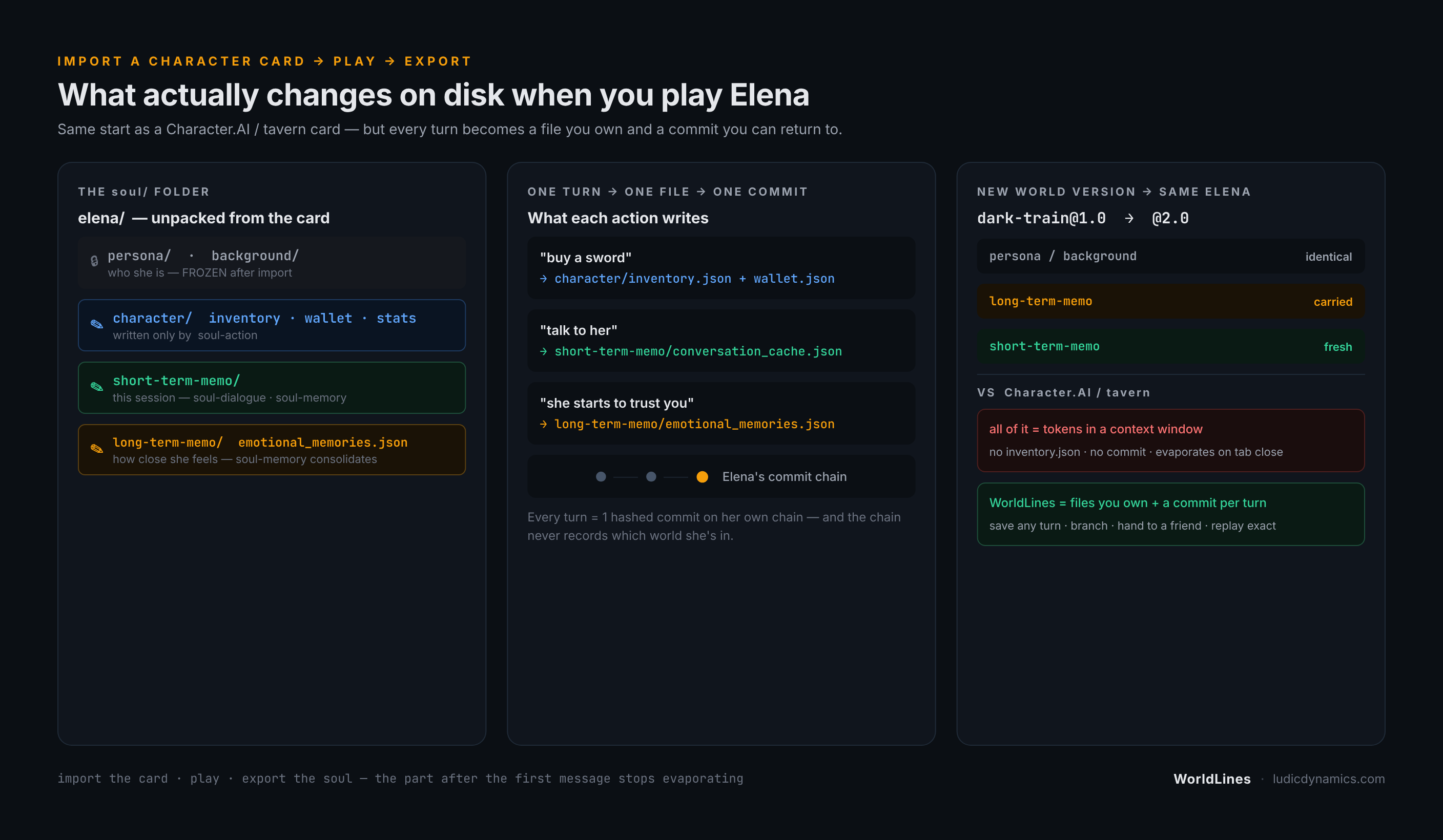
My playthrough with Elena reached the third town in Stoneford. Three big battles. Bandit ambushes. A near-final dungeon I bolted from, then turned around and pushed straight to the far edge of the map. I still don’t know how Elena’s true past will end. I don’t know what’s waiting at the northern end of this isekai journey.
What Needed to Be Solved: Fun Orchestration × Speed × Cheap Tokens
The game worked. But three real problems blocked it:
-
Each turn on Claude Code (CC) was slow. Claude’s free agent loop dives deep into thought, and depth costs latency.
-
Most of my friends weren’t going to pay for ClaudeMax just to play a text adventure.
-
Pure-text orchestration has a weaker visual hook than image/video (this is probably a non-problem after GPT-5.5, but it’s still real today).
After that, I went all-in. After graduating, my co-builder and I poured every available hour into reproducing the agent system on cheaper substrates. The play experience that originally only worked under Claude Code, we got running on DeepSeek and Qwen — faster, much cheaper, and almost as stable.
How We’re Solving It — A Few Hard-Earned Intuitions
I haven’t had time to turn these into a paper yet. They’re working intuitions, but I trust them right now:
-
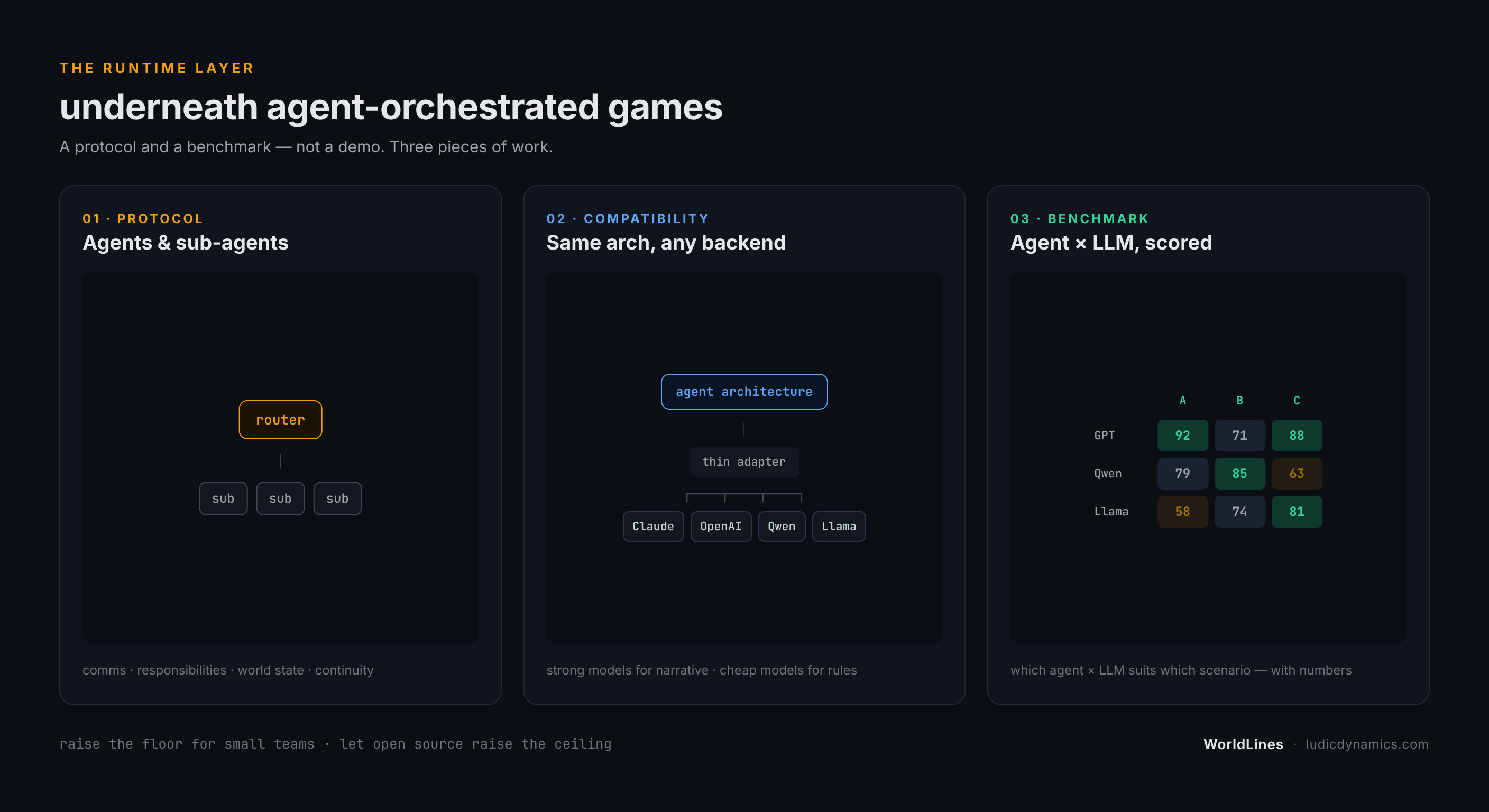
Agent topology matters more than agent count. Going from “one big agent with dozens of tools” to “10 specialist agents + 1 router agent” produced a step-change in stability × freedom × logical rigor. As long as the router is a strong model, the specialists can be smaller. There’s likely a lot more orchestration-topology work to do.
-
Prompt control of an orchestrator is manual labor. Our system was shaped before the CC leaks came out, and my co-builder and I argued constantly about how tight or loose the harness should be. Eventually we built our own benchmarks to settle it. For different tasks, Claude Code and other agent stacks differ in detail. To tune for games specifically: re-read context fewer times, persist more state, customize the orchestration. The result on speed and stability is night-and-day.
-
High-freedom text AI games will be very fun. But: today’s pipelines for direct 3D/2D still have major gaps to fill. GPT-5.5’s game-UI image+animation work is striking, but adaptive UI isn’t deployable yet. 2D/3D needs higher fidelity to match the information density of imagination. Text is lower-dimensional as presentation, but higher-dimensional in information. In an era when everyone has already played Genshin, the gap between imagined adventure density and generated 3D quality is wide. Once that gap is closed, a world model that produces an adventure unique to every player will be a new paradigm.
-
Multi-agent playstyles are wildly diverse. As we run more experiments, more concrete playstyle ideas pile up — and many of them need specialized agent orchestrations to land. I suspect vertical orchestration patterns will end up valuable in other business and entertainment domains too. (If you have thoughts on this, let’s talk.)
Status and What’s Next
As of mid-April, I’ve reproduced the WorldAgent version I had in February.
Through May I’m pushing to reproduce the multi-agent, autonomous-thinking heroine version — the not-fawning, not-bitter, sweet-and-tsundere variety — from Claude Code into the cheaper-substrate engine.
If you want to try the Claude Code build or the current agent build early, take a look! I’ll keep posting May and June progress in this thread.
The engine and the CC version are both open-source on GitHub.
Links
-
Site: worldlines.gg
-
Engine repo (docs / install / templates): github.com/LudicDynamics/WorldLines
-
Starter world: github.com/LudicDynamics/stoneford-worldlines