What Ludic Dynamics Builds
Ludic Dynamics builds AI-driven persistent worlds — text-based game environments where the world runs continuously, characters remember everything, and every player action has real consequences that propagate forward in time.
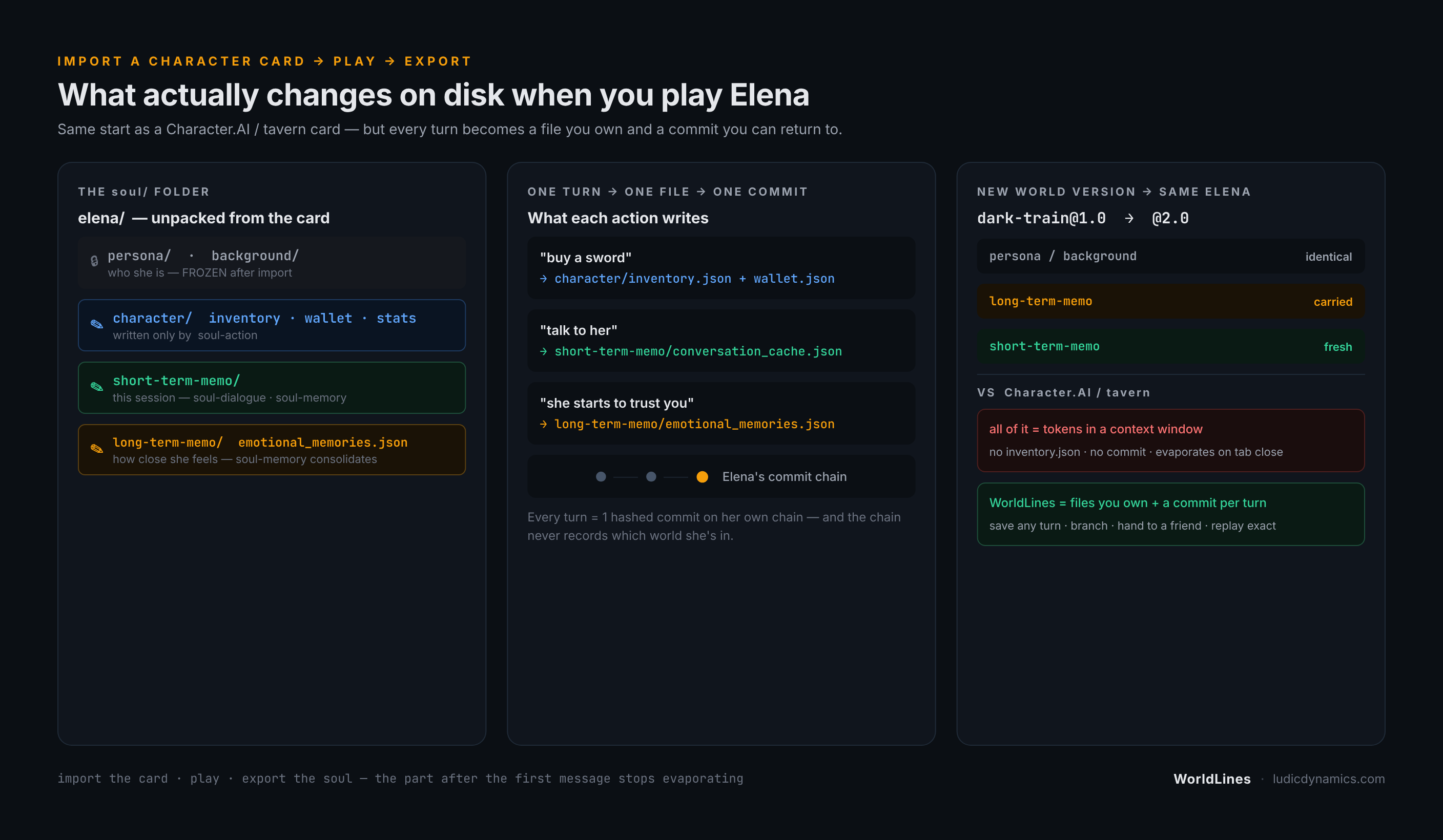
Think of it as the difference between a chatbot and a living world. Most AI roleplay today works like this: you open a page, have a conversation with a character, close the tab, and everything is gone. The character has no memory. The world has no state. Nothing you did matters the moment you leave.
We build the opposite. Our engine maintains a persistent world graph — every NPC, every location, every faction, every event is tracked as living state. When you buy a sword from a merchant, the merchant’s inventory changes. When you insult a guild leader, the guild’s attitude toward you shifts — and that shift ripples outward to every guild member you meet later. When you log off and come back three days later, the world has continued without you. Time passed. Things happened. The story moved.
This isn’t a new idea — it’s what tabletop RPGs have done for decades, with a human game master tracking everything by hand. What’s new is that AI agents can now do this at scale, in real time, for anyone.
How We’re Different
The current AI roleplay landscape breaks into roughly three tiers:
AI chat (Character.AI, etc.) — You talk to a character. There’s no world, no state, no persistence. It’s a conversation, not an experience.
AI narrative (AI Dungeon, SillyTavern, etc.) — You get story continuity within a session. Characters have short-term personas. But the world doesn’t accumulate state across sessions, and there’s no causal engine connecting events.
What we build: AI-driven world — A persistent world graph, managed by a world agent that tracks causality. Character agents with long-term memory, personality models, and autonomous goals. A session that picks up exactly where you left off — not because we saved your chat log, but because the world continued to exist while you were away.
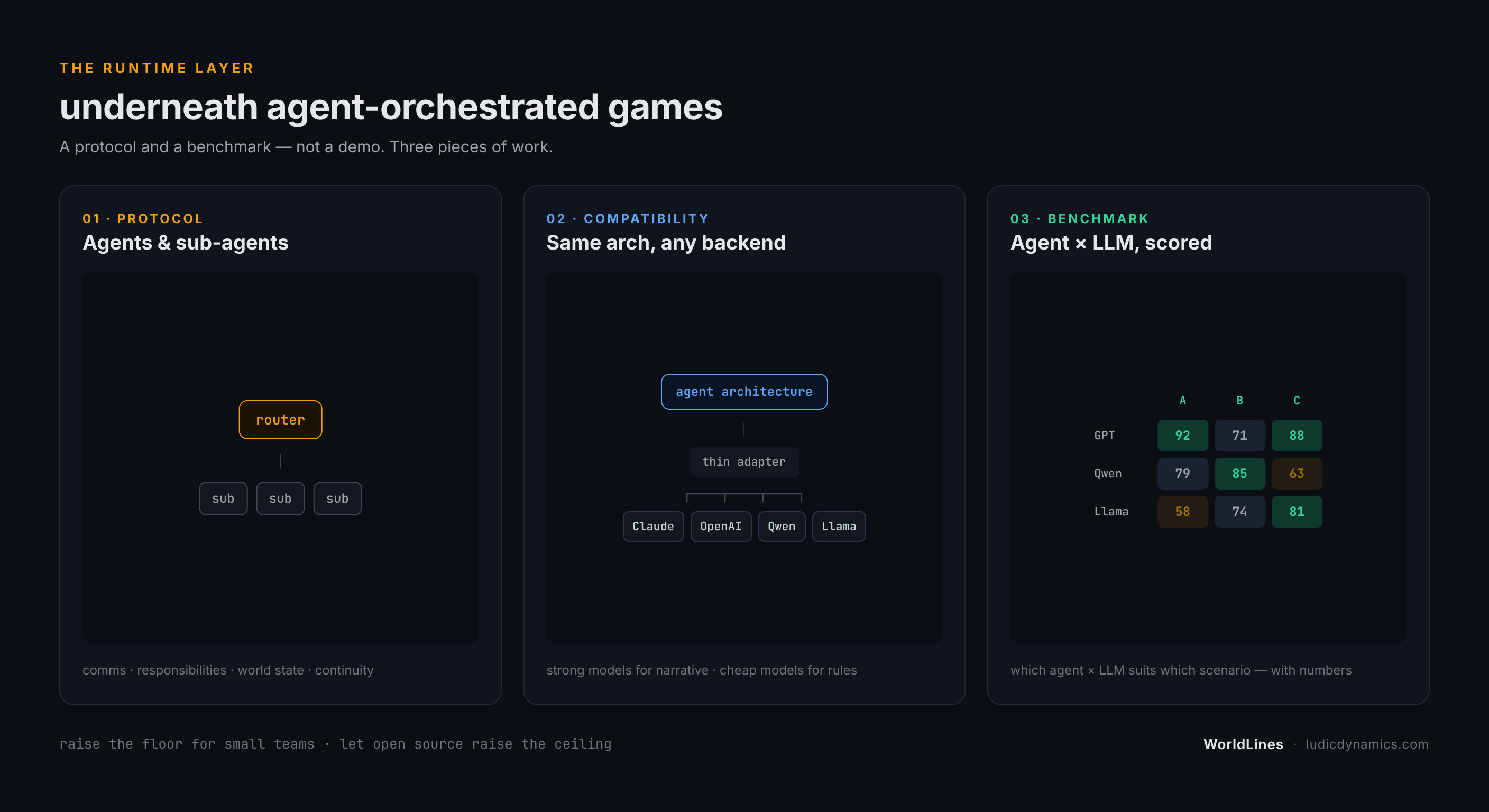
The core architectural difference is the agent layer. We don’t generate text from a single model. We run multiple specialized agents simultaneously:
- A world agent that manages environment, physics, economy, weather, NPC schedules, and event propagation
- Character agents that each maintain their own memory, emotional state, goals, and decision-making — they act even when you’re not watching
- A session orchestrator that coordinates everything into a coherent experience for the player
The result: you don’t play a story. You enter a world. And the world doesn’t care whether you’re there or not — it keeps running.
Why Tokyo
Three reasons, in order of importance.
The culture understands what we’re building. Japan has spent decades taking fictional worlds seriously — not as disposable entertainment, but as complete realities worth investing in deeply. Visual novels with exhaustive world-setting documents. Tabletop RPG communities where game masters publish their sessions as literary works. A creative tradition where “world-view” (世界観) is the foundation, not an afterthought. When we describe our product to people in Tokyo, they don’t ask “why would anyone want this?” They ask “how far along are you?”
The talent intersection exists here. We need people who understand both Transformer architecture and tabletop game design. People who understand both agent memory systems and character-driven narrative. People who understand how 3D rendering and game engines are built, and who are also deeply immersed in traditional narrative games, anime-style online games, and otome games. People who understand psychology, sociology, and economics — and who also run TRPG at high intensity as GMs or DMs. For that, we are profoundly grateful: Tokyo sits at the intersection of academia, the game industry, and independent creative culture, and it has brought us collaborators who could never have gathered together anywhere else.
The creative lineage is here. Some of the works we have long tried to bring into form within our vision — visual novels that can simulate butterfly effects across parallel timelines and layered dream states, tabletop scenarios designed for repeated play and reinterpretation, and games where the weight of a single choice can reorganize an entire story — have been attempted and dreamed of in this city. We build on that lineage, and we take up the challenge of realizing these works in earnest. Our product name, WorldLines, comes directly from the concept of 世界線 (sekaisen) — the idea that each person’s choices create branching paths, and that moving between those paths is one of the most compelling experiences interactive narrative can offer. That cultural resonance is immediate here. Elsewhere, it requires explanation.
Where We Are Now
We’re in cold release. The engine runs. The World Agent and Character Agents coordinate in real time. We have three test worlds live on worldlines.gg — an isekai reincarnation scenario, a modern romance simulation, and a Cthulhu Mythos investigation.
If we had to explain WorldLines in one sentence to someone who has read this far: it is a “Coding Agent System” designed specifically for AIRP games; a “World Engine” where humans and ClawBot can play together; an “AIRP tool” that becomes yours after local installation, where lore and characters can interlink; a “world playground” where you can deeply construct a worldview and share it with others; and a multi-player “AI-TRPG” where people can play — or capture their highlight moments.
It is still very early. The experience is terminal-first and text-dense, for players who care more about depth than polish. This is intentional — we are building first for people who understand what persistent world state means and why it matters, and only then expanding to a broader audience.
If that’s you, come try it.
We will partially open-source and iterate as soon as we can.
— Ludic Dynamics, Tokyo, 2026.03