RESEARCH · IPSJ ENTERTAINMENT COMPUTING 2026 · KYOTO

Living Game Worlds

Multi-Agent LLM Simulation for Living Game Worlds — coordinating world, soul, and player agents over a pub/sub message bus
Yuhang Huang, Chenmiao Li (The University of Tokyo, equal contribution) · Chaowei Fang (Independent Researcher)
IPSJ Entertainment Computing 2026 · Kyoto, September 2026
ABSTRACT
One prompt playing narrator, character, and referee at once is why long role-play sessions fall apart. This system paper splits the job across three agent roles that meet as peers on a pub/sub message bus: a world agent that owns canonical state and closes each turn, M concurrent soul agents with personas, private memory, and agendas of their own, and N player agents rendering a private view per player. Souls run in a bounded pool; the world agent is the single writer, committing schema-validated turns through the Plan–Diff–Validate–Apply kernel of Paper Ⅰ. Agents exchange only transport-agnostic JSON — distribution is designed in, not bolted on. Presented with the playable multi-agent world 時間陣 (Jikanjin).
SYSTEM — THREE ROLES, ONE BUS

Peers on a message bus

No agent calls another directly. World, souls, and players publish and subscribe on one bus — the same topology runs single-process today and distributed tomorrow.

world agent single writer · closes each turn pub / sub message bus · transport-agnostic JSON soul agents ×M · bounded pool player agents ×N · a private view per player
CONCEPT · THREE ROLES MEET AS PEERS — ONLY THE WORLD AGENT WRITES
SINGLE WRITER

world agent

Owns canonical state · validates every consequence · closes each turn.

⇅   PUB / SUB MESSAGE BUS · TRANSPORT-AGNOSTIC JSON   ⇅
×M · BOUNDED POOL

soul agents

One per character — private memory, secrets, agendas. They perceive, decide, and act concurrently.

×N · PRIVATE VIEWS

player agents

One per player — each renders its own narrative projection of the same world.

DEMO — 時間陣 (JIKANJIN) & THE HUB

Presented playable, running live

The paper shipped with 時間陣 (Jikanjin), a playable multi-agent world demonstrated at the EC2026 session in Kyoto. The same runtime powers WorldLines today: every character its own agent, the world agent narrating, an agent map tracking who is where.
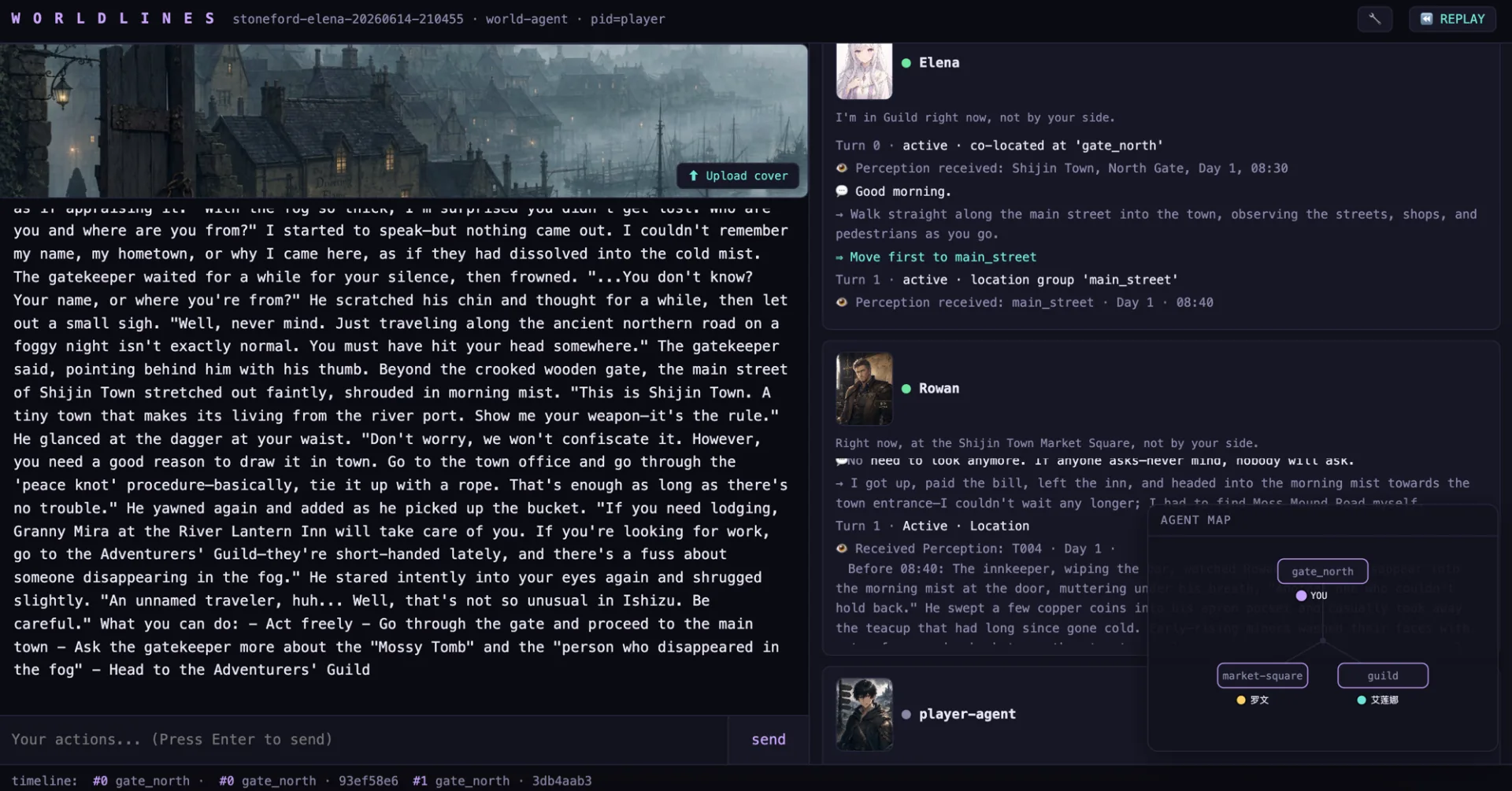
WorldLines hub: Elena, Rowan, and the player agent each with their own feed and avatar, the world agent narrating, and the agent map tracking who is where
THE SAME RUNTIME IN THE WORLDLINES HUB — ELENA · ROWAN · PLAYER-AGENT, EACH ITS OWN MIND; AGENT MAP BOTTOM-RIGHT
RESEARCH SERIES

The papers behind WorldLines

PAPER Ⅰ · CHI PLAY COMPANION '26 · ACM

From Character Role-Play to Orchestrated Reality: LLM-Driven Game World Simulation as a Parameterized-Action POMDP

The formal model — Parameterized-Action POMDP, canonical JSON state, and the PDVA transition kernel.

Paper page → DOI → arXiv →
PAPER Ⅱ · IPSJ EC2026 · KYOTO · THIS PAGE

Multi-Agent LLM Simulation for Living Game Worlds

The society layer — world, soul, and player agents as peers on a pub/sub bus, with the playable demo 時間陣.

PAPER Ⅲ · UNDER ANONYMOUS REVIEW · 2026

RP-Worlds: An Architecture for Unbounded yet Consistent World Simulation via PA-POMDP

The growth paper — play expands the canonical world through validated transitions; it grows without drifting. Preprint after review.

Paper page →

Overview of all three: worldlines.gg/research →

CITATION
@inproceedings{huang2026livingworlds,
  title     = {Multi-Agent LLM Simulation for Living Game Worlds: Coordinating
               World, Soul, and Player Agents over a Pub/Sub Message Bus},
  author    = {Huang, Yuhang and Li, Chenmiao and Fang, Chaowei},
  booktitle = {IPSJ Entertainment Computing Symposium (EC2026)},
  address   = {Kyoto, Japan},
  year      = {2026}
}

The reference implementation is open.

WorldLines — the multi-agent engine for living worlds. File-backed, event-sourced, playable today.

⭐ Star WorldLines on GitHub